
Share Annie Laura Manson's obituary with others.
Invite friends and family to read the obituary and add memories.
Stay updated
We'll notify you when service details or new memories are added.
You're now following this obituary
We'll email you when there are updates.
Select your format and elements to print

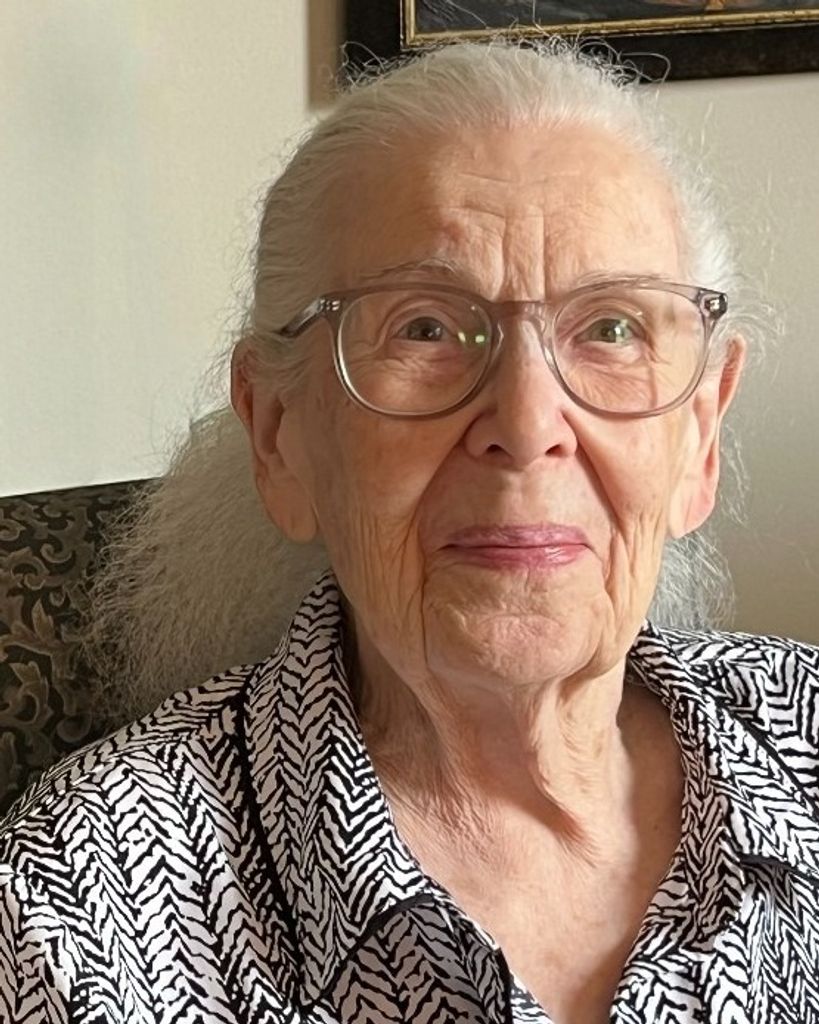
Annie Laura Manson
Aug 21, 1927 — Jan 12, 2026
Share Annie Laura Manson's obituary with others.
Invite friends and family to read the obituary and add memories.
Stay updated
We'll notify you when service details or new memories are added.
You're now following this obituary
We'll email you when there are updates.
Select your format and elements to print
Jan 12, 2026 – The Passing of Annie Laura
My mom died this evening. She was 98.
The last time I saw her smile was today at lunch. I showed her pictures of her beloved ten-year-old (nearly eleven!) granddaughter, Nuala, lounging with a book in her newly-redecorated big girl bedroom. The last word I heard my mom speak was an emphatic “good”, when I told her how much Nuala loves reading.
This made an impression on me, since my mom had been mostly non-verbal and unsmiling in these last few days of illness – drifting in and out of sleep, occasionally staring at me with an intensity I could not parse, before nodding off again. Mostly, though, she would only signal me to hold her hand, which I did.
Annie Laura Forrester was born in Vancouver in the late summer of 1927. Her parents were immigrants. Winifred Edwards was a woman whose family, from the north of Wales, had moved to England, to try to find a better life – like many Welsh people of the era. At some point, she met Robert Forrester, a Scottish man from the Borders whose family, similarly, I assume (because I don’t really know), had also moved to England to find a better life. Neither managed to find such a thing in Liverpool, where their families had settled. I imagine the two youngsters resolved, like their families before them, to continue the search. The problem was, of course, money.
I’m not sure exactly when or how those two met, but I know when and where they married (my mom kept their marriage certificate – now 100 years old). My mother’s story has Robert somehow enlisting in the Canadian army to fight in World War One – choosing allegiance to Canada over England. He survives and, I assume, returns to Liverpool (maybe he wins Win after the war? maybe he’s returning to her?). Meanwhile, Laura, Winifred’s next oldest sister - and the favourite one - comes into a surprise inheritance from a wealthy, elderly woman who had hired her to manage her affairs. Here is a chance that probably none of them had dreamed of. In 1925, Laura, in a life-changing act of generosity, books passage for all three to Canada. The two Edwards sisters and Robert Forrester, traveling by ship, intend to get as far west as possible, which, in Canada in 1925, means Fort William, Ontario (now Thunder Bay). As soon as they disembark, Robert and Winifred marry. I like to imagine Laura as the sole bridesmaid. The three continue west, by train, to Vancouver, where they run out of land. It is there they begin a new life in a new country.
Robert had wanted to be an artist. He was a painter and drawer. His daughter, my mom, boasted to me that he had exhibited with a member of the Group of Seven, before they were called that. But. As the depression gripped the country while my mom was a little girl, painting didn’t seem to be something that would feed a family. He worked in plumbing and eventually in city planning, and finally, because medicine was not what it is today, he died a long lingering death from leukemia. He was young. My mom was 18 when she lost her dad – a father she cherished. I never met him.
Annie’s mom, Winifred, had mad skills. She made clothes for the whole family. She could do fine lace work. She could knit and crochet and embroider and cook. Some of the sweaters she made for me as a kid I passed on to my own daughter. I still wear sweaters she made for my dad (I was too little when she passed to get a bespoke grown-up sweater). Winifred got a job at Vancouver Technical School in food services, with a side-hustle in food prep at the PNE – needing to somehow support her fatherless kids. I remember her fondly. I attribute my love of gardening to her. I remember little me squatting beside her by a planting bed on one of her rare visits to New Brunswick (my parents had moved to Sackville for work – a long way from Vancouver). I loved the idea of planting things in earth, of plunging your hands into the dirt. So did she.
In any case, Winifred and Robert’s first child came before all of that – a baby girl born into the roaring twenties in Vancouver, two years after they were married. They named her Annie Laura – the twinning of an old Scottish song (Annie Laurie) with the sister to whom they owed Canada.
Young Annie was a prodigiously talented student. She played the piano and violin and sang, she ran track, got good grades, and became a well-known child actor. However, the Great Depression was soon to overtake her childhood. Luckily, Laura, though tiny, was a powerhouse. She managed to buy a corner store in Vancouver, and, after divorcing a deadbeat husband, also managed to keep herself and her sister’s family alive through very tough times. My mom worked at Laura’s store as a kid. She remembers reading Action Comics number 1, with its introduction of a new character named Superman. I picture her reading this surrounded, more accurately, by Superwomen. Winifred grew food and chickens in the backyard, and made all the clothes. Laura kept the wolf from the door. Around this time, because Robert and Winifred were, ultimately, poor, my mom was living with them in a cramped third floor apartment. That’s where my Uncle Raymond was born. My mom now had a little brother with which to contend. It was nearing the end of the 1930s. Apparently, my uncle was a handful. This translated in adulthood to a twinkle in his eye, and a love of practical jokes.
As for Laura, she would decide to bind herself to my mom for the rest of her life, and moved with our family everywhere we went – eventually to Sackville, New Brunswick, as family cook and child carer and keeper of much wisdom and love, despite her tiny size. I attribute my own love of cooking to her, and a sense of goodness and generosity that bubbled through the family.
But before that, before New Brunswick, while the Depression gave way to war, Annie and the family moved again to East Vancouver, to an even-cheaper place to live. Annie was ashamed of this address and the poverty it implied back in the 1930s and 40s. It’s hard to imagine now that ANY neighbourhood in Vancouver was cheap, but young Annie would not tell people where she lived. If she ever got a drive home, she’d ask to be dropped off blocks from her house, and would walk the rest of the way unobserved, especially by prospective boyfriends. Many decades later, she still wouldn’t visit East Van with her adult son – me. The echo of being poor, the shame of it, endured for most of her life.
Annie went to UBC at an extraordinary time. She remembers attending the same classes as veterans from the Second World War – years older than my mom and her teenage girlfriends. Thanks to the Canadian government, free tuition was offered to vets – and many soldiers took Canada up on the offer. Annie remembered them with awe. These were not boys, she would say. They were men. Mom recalls UBC being filled with a spirit of release, of hijinx, of dizzying energy. Humans who had survived something terrible could now breath and live.
My dad was one of these men. His little sister was my mom’s age, 19, and also at UBC. Gord was 26. Annie asked – WHO is your big brother?
They were married in 1948. My mom was 20.
Anne (with an “e” now – no longer Annie, a name she felt she was just too grown-up to carry any longer) found happiness with Gordon Manson. She took his name, as was the custom. Though she loved singing and acting, she felt, as did her father before her, that a life in the arts was too big a risk for a girl with her story. But she took part in extracurricular drama as much as she could. Her cohort at the UBC players club included Joy Coghill (a Canadian theatre legend and one of my mom’s bridesmaids), and Robert Clothier (who went on to a big career in Canadian TV). Mom became a high school teacher. So did my Dad.
Anne moved with Gord to Dawson Creek in the 1950s – mile zero of the Alaska Highway, as mom would always describe it. It was a frontier town, and they both taught. My brother, Paul, was adopted from a single mom who was in dire straits, and who asked my mom if she would take this baby. Mom says it was a different time, with less paperwork. She and Gord said yes.
Dawson Creek. Mom remembered sidewalks made of wooden boards. She remembered mud in the Spring that you would sink in up to your knees. She remembered the Peace River suspension bridge collapsing when its anchors pulled out of the permafrost. After it folded up like a broken spring, everyone had to drive across the river on two rows of planks laid on a railway trestle. I’m not sure if this contributed to her later fear of heights or not, but it certainly takes my breath away to imagine driving over something like that. She spoke of the things you always carried with you in the trunk of your car, in case you broke down in a blizzard. She and my dad were more than a bit hard core, I now suspect. Mom later said she always thought she would have fared well as a pioneer woman in an earlier age. I could picture her with an axe and a shotgun, keeping the homestead together.
From way up North, they moved way down south to Victoria, on Vancouver Island. Dad taught, this time at a university. I was born. Then we all moved back towards the north to Edmonton. Dad did his PhD. Mom supported him. I had my first memory (pulling the cord on a city bus to get it to stop, while riding with my great aunt Laura).
And then came the big job offer for my Dad in about 1965 to create a Department of Education at Mount Allison University. The family moved again – all the way East. It was a great career move for my Dad. My mom and great aunt thought it was like going back to the Dark Ages. The education system in New Brunswick at the time was not what one would call progressive (I, on the other hand, loved Sackville – the Maritimes, I thought – and still think – are a great place to grow up). My mom eventually found her groove – she thrived at work, lobbied for a more modern curriculum, and was ultimately chosen to run the English department at Tantramar Regional High School.
And she brought theatre to the youth of Sackville.
Sackville was where Anne and Gordon Manson settled for the next couple of decades. Anne was respected, and often beloved as a teacher and the leader of the High School Drama Club she founded. For her 98th birthday last August here in Toronto, I put together a book with testimonials from some of her former students. She changed lives. She accepted kids for who they were, and offered understanding and a place to be themselves. Mrs. Manson, as she was known, was an example of a woman leader to girls, and of a compassionate grown-up to children who needed support. She introduced Canadian literature into the high school curriculum. She directed plays at the high school, and musicals at the university. Countless students were thrown life lines by my mom, by her dedication to them and to the ideal that education and the arts could be an enormous, positive force for children looking to create a life they could fit themselves into. Through it all ran the same thread of generosity my Aunt Laura exhibited. It would never leave her.
Much living happened in all the years that followed. Anne and Gord were together for just shy of 60 years, when my dad died. That was in Kamloops, BC, where they had retired (all the way back West). After Dad’s death, mom moved back to a very different Vancouver to be with my brother for a couple of years. With the birth of my daughter, she moved yet again, into our house here in Toronto.
Mom loved Nuala with an enormous and sustaining love. I am deeply happy that my daughter got to experience an extended family, with me, Neema, and a live-in grandmother, just as I had done with my great aunt Laura living with us (Nuala’s other fabulous grandmother, Farrella, moved into my mom’s basement apartment, once my mom moved out for health reasons – so the multi-generation tradition continues, and the label “Granny suite” became inescapably literal).
Mom was active. She found places to visit on her own in a city she had never known (chief among them: a restaurant called the Junction Grill, where the staff essentially adopted her). She was still mowing the lawn at 92. It wasn’t until about 93 that age really started to catch up with her. Congestive heart problems, a recurrence of breast cancer (that she had beaten decades before), diabetes, and then a slow series of micro-strokes leading to vascular dementia. But she still managed to ride through all of this, and retain her essential self for five more years. Then, a couple of weeks ago, a large gallstone escaped her gall bladder and lodged in her intestine – a rare condition called gallstone ileus. Inoperable in any safe way at her age. This spelled the end.
I am glad Robert and Winifred moved to Canada a century ago. Canada, with its institution of free health care, saved the lives of my mom twice, of my Dad, at least once, and, spectacularly, of my co-parent, Neema, and our daughter (due to a childbirth that would have been fatal in an earlier era). The health system took amazing care of my mom through all her final challenges, as it did with my father before her. It eased her death, too. I am proud that my country can do this for its people.
In this last phase of her life, Anne moved into Long Term Care, and was lucky to find herself cared for by a group of wonderful, attentive and heroically generous people. Over and over, I have met health workers who are among the most admirable, exemplary humans I have ever met. During this phase, my mom’s name reverted back to Annie – full cycle after almost a century. She was liked. She would sing and yodel “helloooo” to the staff, who would yodel “Helloooo Annie” back to her. All of her stress and worry was mostly removed by her dementia (lucky again), and Annie found comfort.
A few days ago, in hospital, where the news of her terminal condition became clear, she became suddenly chatty. It was extraordinary. We would have conversations – something her dementia had years ago rendered mostly impossible. But the conversations were remarkable in that they moved through timelines and locations seamlessly. She could be in Vancouver and in Victoria and in Toronto simultaneously, at funerals of friends, at her mom’s house, with her husband, with me – moving through these times and places with the undisturbed logic one finds in dreams. It was beautiful:
That music is nice.
There is no audible music playing.
And don’t forget Laura in all this, And the store.
I think you may be back in time, Mom.
No I’m not!
That sounds like a symphony. Close by.
She hands me some imaginary garbage. I throw it out.
There’s one decision we can make. If I die. And if you’re about to die. That’s to think about our child.
I’m Ross, Mom, not Gord.
Oh yes, of course. But we should think about little Nuala.
Looks into the distance
Ah the restaurant is empty…
*
I should phone my mom.
*
It’s amazing how you get that effect.
What do you mean?
She shows me her hands, fingers spread, commenting on what she sees – something invisible to me.
Very good.
Are you happy?
Very happy. She laughs.
*
I got the call earlier tonight that her breathing was shallow. “Should I come now?” “Yes. You should come now”. It was about 10pm.
Annie had moved back from the hospital into palliative care at her LTC five days before to be among her possessions and flowers and the caregivers who knew her. I had left her at around two in the afternoon. I can’t remember what the last thing I said to her was – “Love you, old thing” or “See you tomorrow”? I wasn’t expecting to never see her again. I drove to the LTC after the phone call, but arrived about 12 minutes after she’d passed. Apparently, it was peaceful. I suspect, like so much about her life, she had somehow arranged to have her passing be exactly like this: organized, and causing a minimum of trouble.
Annie Laura Manson now lives in me, Ross Raymond, and my brother, Paul Gordon, and her granddaughter, Nuala Omolara, and all the many people for whom she made a difference. It is what we do for one another.
*
Ross Manson Toronto, 2026
Videos
Guestbook
Visits: 674
This site is protected by reCAPTCHA and the
Google Privacy Policy and Terms of Service apply.
Service map data © OpenStreetMap contributors
This obituary is protected against unauthorized reproduction or redistribution without the funeral home's or family's consent.